

Screen Print vs DTG: Which Method Wins for Your Apparel?
Screen printing and DTG (direct-to-garment) printing are the two dominant methods for custom apparel, and the right choice depends entirely on your order size, design complexity, and fabric. Here’s the fast breakdown before we go deep:
- Screen printing forces ink through mesh stencils, one color at a time, producing thick, opaque, highly durable prints that last many washes without fading. Best for larger bulk orders with bold, simple designs.
- DTG printing uses digital inkjet technology to spray water-based ink directly onto fabric fibers, capturing photorealistic detail and unlimited colors in a single pass. Best for short runs, one-offs, and complex artwork.
- Cost favors DTG at low quantities because there are no screen setup fees. Screen printing becomes more cost-effective as volume climbs past 24 units, and it keeps getting cheaper per shirt from there.
- Turnaround is faster with DTG. A single shirt can go from digital file to finished print in under 20 minutes. Screen printing setup adds days to production.
- Fabric compatibility splits the two methods sharply. Screen printing handles cotton, polyester, and athletic blends without adjustment. DTG performs best on 100% cotton and loses vibrancy on high-polyester fabrics without special pretreatment.
- Design complexity is DTG’s territory. Gradients, photorealistic images, and hundreds of colors cost nothing extra with DTG. Screen printing adds a screen and cost for every color.
Your call comes down to four variables: order size, design complexity, fabric type, and budget.
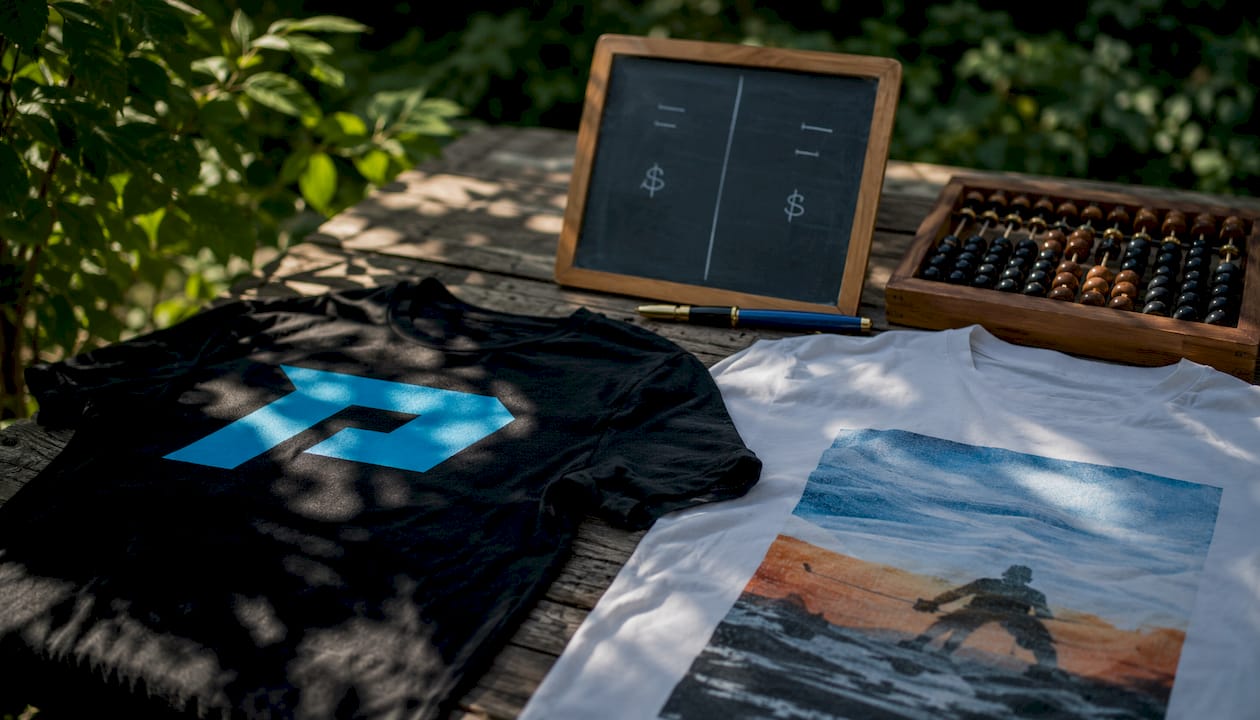
How screen printing works and why it still dominates bulk orders
Screen printing pushes ink through a fine mesh screen onto fabric using a rubber squeegee. Each color in your design gets its own separate screen, and the ink cures in a conveyor dryer at around 320°F. The result is a thick, tactile print that sits on top of the fabric rather than soaking into it.
The industry standard ink is plastisol, a PVC-based formula that bonds to itself during curing rather than penetrating the fiber. That surface-level deposit is what gives screen prints their characteristic weight, opacity, and bold color pop. On dark garments especially, plastisol white delivers a level of coverage that digital methods struggle to match.
Screen printing’s strengths are real, but they come with trade-offs:
- Durability: Prints routinely survive 50+ wash cycles without cracking or fading, making this method the go-to for workwear, uniforms, and team gear.
- Color vibrancy: Thick ink layers produce bold, saturated tones that hit hard on both light and dark fabrics.
- Specialty inks: Metallic, puff, and glow-in-the-dark effects are exclusive to screen printing. DTG cannot replicate them.
- Fabric range: Works on cotton, polyester, nylon, and performance blends without pretreatment adjustments.
- Setup cost: Each screen costs money and time to prepare. That upfront investment only makes sense when it’s spread across a larger run.
- Color count limit: Most print shops cap designs at around nine colors, and each additional color adds cost.
Pro Tip: If your design uses fewer than six colors and your order tops 24 pieces, screen printing will almost always beat DTG on cost, durability, and color impact. Clean vector files (AI or EPS format) make screen separation faster and cheaper.
Screen printing is the backbone of branded merchandise, event shirts, team uniforms, and any job where Pantone color accuracy matters. For youth sports branding, where color consistency across dozens of garments is non-negotiable, screen printing is the reliable choice.
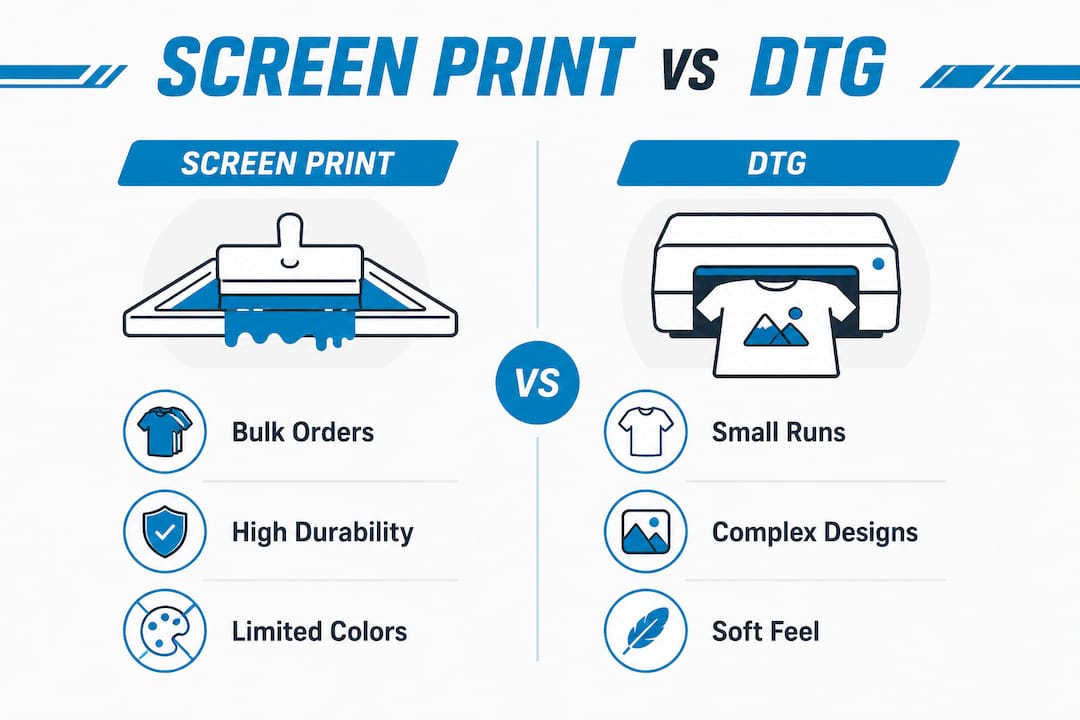
How DTG printing works and when it’s the smarter call
DTG printing is modified inkjet technology. The machine reads a digital file and sprays water-based ink directly onto the fabric surface, no screens, no color separation, no per-color setup fees. The ink bonds with cotton fibers rather than sitting on top, which gives DTG prints a softer hand feel compared to screen printing.
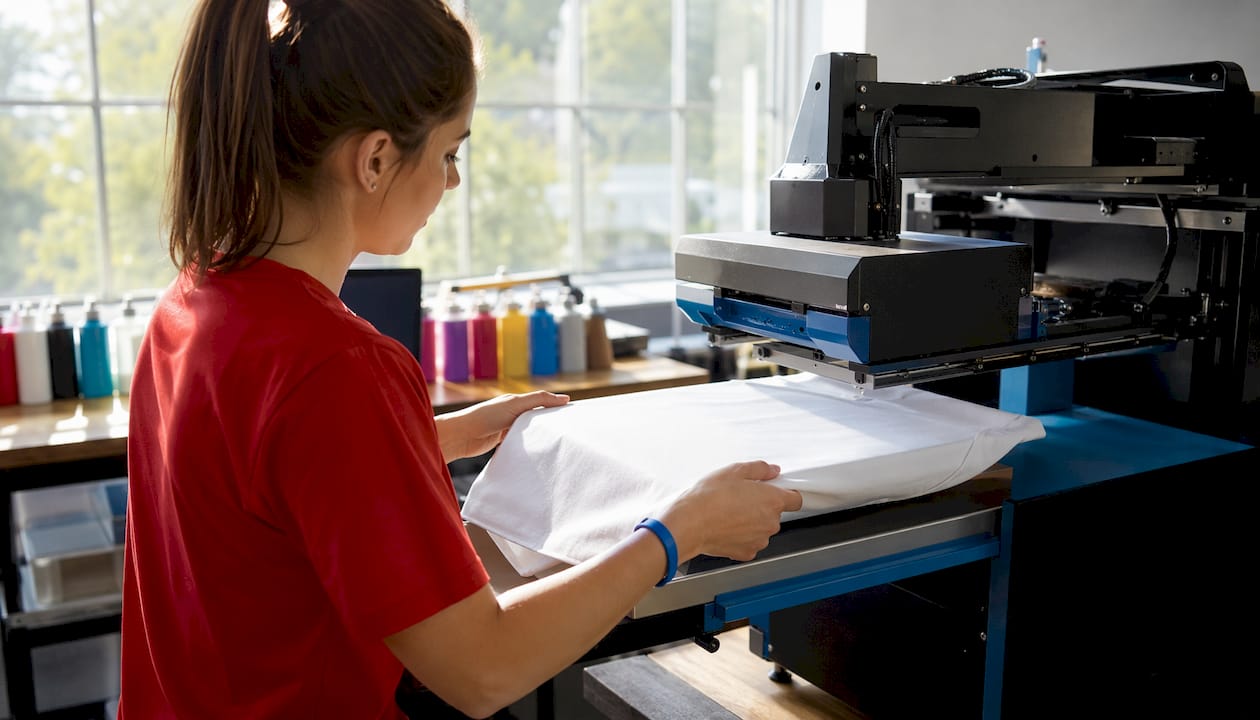
Dark garments require one extra step: a white underbase pass before the color layer fires. That underbase adds both print time and ink cost, but it’s what allows full-color designs to show up vividly on black or navy fabric. Without it, colors would look washed out.
Here’s where DTG earns its keep:
- Design complexity: Photorealistic designs and unlimited color palettes are handled in a single pass. Gradients, soft transitions, and detailed illustrations add zero cost.
- No minimums: One shirt is as easy to produce as ten. This makes DTG the backbone of print-on-demand fulfillment and custom one-off orders.
- Speed: Minimal setup means production can start immediately. A single shirt takes under 20 minutes from file to finished print.
- Soft feel: Because ink absorbs into the fiber, DTG prints feel like part of the garment rather than a layer on top of it.
- Fabric limitation: DTG performs best on 100% cotton. On polyester blends above 50% poly content, prints often look dull or fade quickly without specialized pretreatment chemistry.
- Durability gap: DTG prints on 100% ringspun cotton with correct pretreatment perform well, but they typically last around 30–40 washes before noticeable wear, shorter than screen printing’s lifespan.
Pro Tip: Always submit high-resolution PNG files with transparent backgrounds for DTG. The printer reads every pixel, so low-resolution artwork will show up exactly as blurry as it looks on screen.
DTG is the natural fit for small-batch college apparel orders, limited-edition drops, personalized gifts, and any job where the design changes from shirt to shirt. If your business model depends on variety and flexibility, DTG is the tool that makes it possible.
Print quality and durability: how screen printing and DTG actually compare
Print quality is where the two methods diverge most clearly, and the difference comes down to where the ink ends up.
Screen printing ink sits on top of the fabric, creating a thick, opaque layer that resists wear. Screen-printed apparel typically withstands 50+ washes without fading, whereas DTG prints on 100% cotton last around 30–40 washes before noticeable wear. That gap matters for garments that take a beating, like hockey jerseys, team hoodies, and everyday streetwear that gets washed frequently.
DTG trades longevity for detail. The ink bonds into the fiber, allowing for smooth gradients, photographic accuracy, and color transitions that screen printing simply cannot reproduce without complex halftone separations. For artwork that demands nuance, DTG wins on output quality even if it concedes on long-term durability.
Durability snapshot: Screen printing leads at 50+ washes. DTG on 100% cotton averages 30–40 washes. On polyester blends, DTG durability drops further without specialized pretreatment.
Advances in DTG ink formulations are closing the durability gap, but screen printing still leads for bold colors on bulk orders. On dark garments, plastisol white from a screen press is typically more opaque than DTG white underbase, making highly saturated colors on black shirts more vibrant via screen printing.
| Attribute | Screen printing | DTG printing |
|---|---|---|
| Resolution | High for solid colors; halftones for detail | Excellent for gradients and photorealistic art |
| Opacity | Very high; thick ink layers cover dark fabrics well | Moderate; requires white underbase on dark garments |
| Durability | 50+ washes typical | 30–40 washes on 100% cotton |
| Hand feel | Raised, tactile surface | Soft, absorbed into fabric |
| Color range | Up to ~9 colors per design | Unlimited colors, no added cost |
| Best for | Bold, solid designs on bulk orders | Complex, detailed, or photorealistic artwork |
Design complexity and color: which method handles your artwork?
The design you’re printing should drive your method choice as much as order size does. These two processes handle artwork in fundamentally different ways, and forcing the wrong one leads to either blown budgets or disappointing output.
Screen printing suits simple, high-contrast designs. Think bold typography, geometric shapes, team logos, and solid-color graphics. Each color requires its own screen, so a six-color design means six screens, six setups, and six opportunities for registration error. Most print shops cap designs at around nine colors, and cost climbs with every color added.
DTG handles complexity without blinking. Photorealistic designs and unlimited color palettes print in a single pass regardless of how many colors or how fine the detail. A 200-color gradient illustration costs the same to print as a two-color logo. That’s a genuine advantage for brands built on intricate artwork or frequently changing designs.
Key considerations by design type:
- Simple logos, bold text, team marks: Screen printing delivers sharper edges and more vibrant color on these.
- Photorealistic images, gradients, detailed illustrations: DTG handles these without the color separation overhead.
- Specialty effects (foil, puff, metallic): Screen printing only. These effects require physical screens and specialty inks that digital printing cannot replicate.
- Variable data (names, numbers, personalization): DTG only. Screen printing cannot economically change content from shirt to shirt.
Pro Tip: Match your method to your artwork first, then check your order size. A complex design on a 50-piece run might still favor DTG if the color count would require eight or more screens, since screen setup costs can erode screen printing’s bulk price advantage fast.
One misconception worth addressing: screen printing can handle fine detail. High mesh counts in the 305–355 range reproduce halftone detail and subtle tonal gradients cleanly. The real constraint is color count, not resolution. If your design has three colors and clean edges, screen printing can hold detail that surprises people who assume it’s only for chunky graphics.
Fabric compatibility and production speed: what you need to know before ordering
Fabric choice and turnaround time are two variables that often get overlooked until they cause problems. Get these right upfront and you’ll avoid reprints, delays, and frustrated customers.
Fabric compatibility:
- Screen printing works on cotton, polyester, nylon, and performance blends without adjustment. Screen printing is more versatile across fabric types, including blends and synthetic athletic materials, making it the stronger choice for performance apparel and athletic wear.
- DTG performs best on 100% cotton. On polyester blends above 50% poly content, prints often appear dull or fade quickly without specialized pretreatment chemistry. For dark performance fabrics or athletic wear, screen printing is the more reliable choice.
- DTG on dark garments requires a white underbase pass before the color layer, adding both production time and ink cost. Plastisol white from a screen press is typically more opaque, giving screen printing a vibrancy edge on dark fabrics.
Production speed:
- Screen printing requires 7–10 days for production due to setup. Creating screens, mixing inks, and registering the press takes time regardless of order size.
- DTG can complete orders in a few days thanks to digital, on-demand printing capability. A single shirt can go from file to cured print in under 20 minutes.
- For rush orders or one-off custom pieces, DTG is the clear winner on speed. Screen printing’s setup time is fixed whether you’re printing 10 shirts or 1,000.
If you’re building a hockey apparel line with performance fabrics, polyester blends, or moisture-wicking materials, screen printing handles those substrates without the pretreatment complications that DTG runs into. For 100% cotton tees and hoodies with complex artwork on a tight timeline, DTG gets the job done faster.
Cost breakdown: screen printing vs DTG at different order sizes
Cost is where most people make the wrong call, usually because they assume DTG is always cheaper. It isn’t. The economics depend entirely on volume.
Screen printing carries high upfront setup costs. Each screen costs money to produce, and those costs are fixed regardless of how many shirts you print. Spread across a large run, that setup cost becomes negligible per unit. On a small run, it’s punishing. Screen printing is cost-effective for bulk orders with setup costs amortized over volume, while DTG costs are relatively flat per unit, making it better for small runs.
DTG has no screen setup fees. The cost per shirt stays essentially flat regardless of quantity, which is both its strength and its limitation. At low volumes, that flat rate beats screen printing’s setup-heavy pricing. At high volumes, screen printing’s per-unit cost drops well below DTG’s floor.
The crossover point lands around 24 units. Below that, DTG wins on cost. Above it, screen printing wins and gains cost advantage with larger volumes.
| Order size | Screen printing (est. per shirt) | DTG (est. per shirt) | Cost winner |
|---|---|---|---|
| 1 shirt | $10–$20 | $4 | DTG |
| 24 shirts | — | $4 | DTG (slight edge) |
| 25 shirts | — | $4 | Screen printing |
| — | — | $4 | Screen printing |
| 24+ shirts | — | $4 | Screen printing (decisively) |
Estimates sourced from Printable Press cost comparison.
For small business owners building a print-on-demand model or testing new designs, DTG’s flat pricing and zero minimums make it the practical starting point. As your order sizes grow consistently above 24–36 pieces per run, screen printing becomes the stronger business tool on every metric: cost, durability, and output consistency.
One more cost factor worth flagging: design color count affects screen printing pricing directly. A two-color logo is cheap to set up. An eight-color design requires eight screens and eight setups. If your artwork is complex and your order is mid-size, run the numbers on both methods before committing.
Expert recommendations: how to choose between screen printing and DTG
The choice between screen printing and DTG isn’t a permanent brand allegiance. It’s a production decision made per job based on design complexity, volume, and the specific features you need. Experts across the apparel industry consistently land on the same framework.
Key guidance from industry practice:
- Under 24 shirts with complex or photographic artwork: DTG. No setup costs, no color count limits, fast turnaround.
- Over 24 shirts with bold, simple designs: Screen printing. Cost drops sharply with volume, and durability leads in side-by-side longevity tests.
- Any specialty ink effect (foil, puff, metallic, glow-in-the-dark): Screen printing, always. These effects require physical screens and specialty inks that digital printing cannot replicate.
- Print-on-demand fulfillment with no minimums: DTG, always. Screen printing cannot economically serve this model.
- Pantone color accuracy for brand consistency: Screen printing. Spot color matching is precise and repeatable across large runs.
- Variable data (personalized names, numbers): DTG. Screen printing cannot change content from shirt to shirt without new screens.
Volume crossover: The 24-unit threshold is where screen printing becomes more cost-effective. Below it, DTG wins on cost. Above it, screen printing wins on cost and durability.
Two persistent myths are worth correcting directly. First, DTG is not always cheaper. At low quantities it wins, but its per-shirt cost stays flat while screen printing’s cost drops sharply with volume. A 100-shirt corporate run priced with DTG when screen printing is available is a costly mistake. Second, screen printing cannot handle detailed artwork is outdated thinking. High mesh counts reproduce fine halftone detail cleanly. The real constraint is color count, not resolution.
The most flexible production operations run both methods. DTG handles low-volume custom work that screen printing cannot price competitively. Screen printing handles bulk orders where DTG’s flat per-unit cost becomes indefensible. For specialty apparel brands, selecting screen printing for simple logos and DTG for complex illustrations maximizes cost-effectiveness and product value across the full catalog.
Key Takeaways
Screen printing dominates bulk orders with superior durability and bold color, while DTG wins on design complexity, flexibility, and cost for runs under 24 pieces.
| Point | Details |
|---|---|
| Durability gap is real | Screen printing lasts 50+ washes; DTG on 100% cotton averages 30–40 washes before noticeable wear. |
| Cost crossover at 24 units | DTG is cheaper below 24 shirts; screen printing becomes more cost-effective above that threshold. |
| Turnaround favors DTG | DTG completes orders in 3–5 days; screen printing typically requires 7–10 days due to setup. |
| Fabric matters for DTG | DTG performs best on 100% cotton; screen printing handles polyester blends and athletic fabrics without adjustment. |
| Use both for full flexibility | Running screen printing for bulk simple designs and DTG for complex small runs maximizes cost and quality across your catalog. |
Gear that speaks the language of the game
You know your apparel matters. Whether you’re on the ice or repping the sport in everyday life, the print quality on your gear tells people exactly where you stand.
At Puckfuel, every hoodie, tee, hat, and piece of drinkware is built for people who live the hockey lifestyle. Bold designs. Premium materials. Gear you wear with pride, not just on game day.
Shop Puckfuel hockey apparel and find the piece that fits your game.