

Hat Size Guide: Measure Right and Fit Every Time
Hat size is the circumference measurement of your head at the point where a hat sits, typically about 1 inch above your ears and eyebrows. Get that number wrong and every hat you buy will either squeeze your temples or slide down over your eyes. The US hat sizing formula divides your head circumference in inches by pi (3.14), rounded to the nearest 1/8 inch. A 22-inch head equals a US size 7. A 23.125-inch head equals a size 7 3/8. Knowing your exact number before you shop saves you returns, frustration, and a hat that never quite looks right.
How to measure your hat size at home
Measuring your head takes under two minutes and requires one tool: a soft fabric measuring tape. If you don’t have one, a piece of string and a ruler work just as well.
Step-by-step measurement process:
- Stand in front of a mirror so you can see the tape placement clearly.
- Wrap the tape around your head, positioning it roughly 1 cm above your ears and 2 cm above your eyebrows.
- At the back, make sure the tape rests on the occipital bone, the slight ridge at the base of your skull. Placing the tape too high or too low throws off the measurement.
- Keep the tape snug but not tight. You should be able to slide one finger underneath it comfortably.
- Note the measurement in both centimeters and inches.
- Measure two or three times and use the largest reading. Slight shifts in tape angle change the number, and the larger measurement gives you the most comfortable fit.
Pro Tip: Measure your head with the hairstyle you plan to wear under the hat. Thick or styled hair adds real volume. Add 1 to 1.5 cm to your measurement if you wear your hair up or have a high-volume style.
One detail most people miss: too tight a fit causes headaches within an hour of wear. The pinky-finger clearance test is your check. If you can’t slide your pinky between the hat and your forehead, size up.

What are the different hat sizing systems?
Hat sizing is not universal. The US, UK, and European markets each use a different scale, and alpha sizes (S, M, L, XL) add another layer of variation.
US numeric sizing uses the formula above. Head circumference in inches divided by pi, rounded to the nearest 1/8 inch. A 22-inch head is a size 7. A 23.5-inch head is a size 7 1/2.
EU sizing is the most straightforward. Your head circumference in centimeters is your EU hat size. A 59 cm head is an EU size 59. No math required.
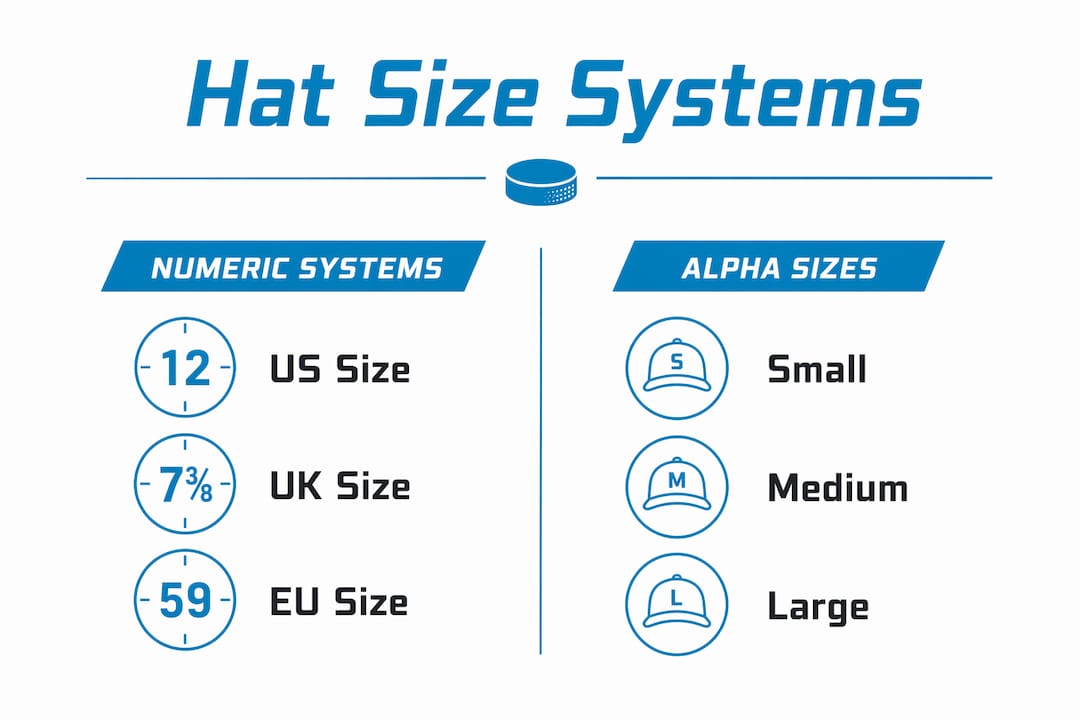
UK sizing runs slightly smaller than US sizing. A US size 7 3/8 equals a UK size 7 1/4. The difference is small but matters when ordering from international retailers.
Alpha sizing (S, M, L, XL) is the least reliable system. Generic size labels vary widely between brands, and a Medium from one manufacturer may span two numeric sizes. A size M might cover 56–58 cm at one brand and 57–59 cm at another. Always cross-reference the alpha label with the brand’s actual centimeter range.
| Head circumference (cm) | Head circumference (in) | US size | EU size | Alpha size |
|---|---|---|---|---|
| 54–55 | 21.25–21.75 | 6 7/8 | 54–55 | XS |
| 56–57 | 22–22.5 | 7–7 1/8 | 56–57 | S |
| 58–59 | 22.75–23.25 | 7 1/4–7 3/8 | 58–59 | M |
| 60–61 | 23.5–24 | 7 1/2–7 5/8 | 60–61 | L |
| 62–63 | 24.5–24.75 | 7 3/4–7 7/8 | 62–63 | XL |
The average adult head circumference is approximately 59 cm (23.25 inches) for men, mapping to a Large or US size 7 3/8, and 57 cm (22.5 inches) for women, typically a Medium. These averages are useful reference points, but your personal measurement always takes priority.
Common mistakes that ruin your hat fit
Most bad hat fits trace back to one of four errors. Knowing them upfront saves you from buying the wrong size twice.
- Measuring too tightly. Pulling the tape snug against your skin gives a smaller reading than your actual hat-wearing circumference. The tape should sit flush, not compress.
- Wrong tape position. Placing the tape across the middle of your forehead instead of 2 cm above your eyebrows adds centimeters that don’t reflect where the hat actually sits.
- Relying on average sizes. Head shapes vary significantly. Buying a size M because you think you’re “average” skips the one step that guarantees fit.
- Ignoring hair volume. Measuring with wet, flat hair and then wearing the hat over a full blowout creates a tight fit. Add 1 to 1.5 cm allowance for styled or voluminous hair.
Pro Tip: When you land between two sizes, always go with the larger one. Smaller hats are harder to stretch, but a slightly loose hat is easy to adjust with a sweatband insert or hat tape.
Sweatbands and internal hat tape are legitimate fixes for a hat that runs slightly large. A foam insert along the inner band reduces the circumference by 0.5 to 1 cm without altering the hat’s shape. Going too small has no clean fix. Stretching a structured hat risks warping the brim and breaking down the crown.
How does hat style affect your sizing choice?
Your head circumference stays the same regardless of hat style. How that measurement translates into a comfortable fit changes based on the hat’s construction, material, and adjustment system.
Fitted hats require the most precise sizing. Structured caps, like the classic 59Fifty style, have no adjustment mechanism. Your numeric size is the only variable. A 59 cm head needs a size 59 or EU equivalent. No wiggle room.
Adjustable hats are more forgiving. Snapbacks, strapbacks, and flexfit styles cover a range of roughly 56 to 61 cm, accommodating Medium through XL. These are the right choice if your measurement falls between two numeric sizes or if you share hats with others.
Structured hats with stiff brims and defined crowns need slightly more room than their stated size suggests. The rigid construction does not flex to your head shape. Sizing up by one step gives your headroom to settle without the hat sitting high on your crown.
Soft and unstructured hats tolerate more variance. Beanies, bucket hats, and casual caps adapt to your head shape over time. A size M in a soft knit beanie fits differently than a size M in a structured snapback.
A few practical rules for applying your measurement across styles:
- Use your exact circumference for fitted and structured hats. Never guess.
- For adjustable styles, confirm the brand’s stated size range covers your measurement.
- Use size charts as starting points but confirm with brand-specific measurements. Internal sweatband depth and crown shape vary between manufacturers and affect real-world fit.
- If you wear a helmet or beanie under your hat seasonally, add 1 to 2 cm to your base measurement when selecting that hat.
- Check whether the hat lists its size in US, EU, or alpha format before ordering. Misreading the system is the most common online ordering mistake.
Key takeaways
Accurate head circumference measurement is the single most reliable way to get a hat that fits well, looks right, and stays comfortable all day.
| Point | Details |
|---|---|
| Measure with a fabric tape | Wrap 1 cm above ears and 2 cm above eyebrows; rest tape on the occipital bone at the back. |
| Take multiple readings | Measure two or three times and use the largest number for the best comfort. |
| Know your sizing system | US, EU, UK, and alpha sizes all differ; always cross-reference with centimeter measurements. |
| Account for hair volume | Add 1 to 1.5 cm to your measurement if you wear styled or high-volume hair. |
| Size up when in doubt | A slightly loose hat is adjustable; a hat that’s too small causes headaches and cannot be stretched. |
Why I think most people are overthinking the wrong part of hat sizing
People obsess over brand, colorway, and style. They spend 20 minutes picking the right logo placement and 20 seconds on sizing. That’s backwards. A hat that fits badly looks bad regardless of how good the design is. I’ve seen players at the rink wearing premium gear with their cap sitting two inches off their head because they grabbed a size M out of habit.
The part most people miss isn’t the measurement itself. It’s the hair factor. I’ve watched people measure perfectly, order correctly, and still end up with a tight hat because they measured with wet, flat hair and then wore it over a full head of styled hair. That 1 to 1.5 cm allowance isn’t a suggestion. It’s the difference between a hat you wear every day and one that sits in your bag.
My other consistent observation: people resist sizing up because they think a larger size means a bigger hat. It doesn’t. A size 7 5/8 and a size 7 1/2 look identical on a shelf. The difference only shows up on your head, where the larger size sits naturally and the smaller one leaves a red line across your forehead by noon.
Measure your head once, do it right, and you’ll never have to guess again. Your hat should feel like part of your look, not a distraction from it.
— Tim
Puckfuel hats: built for the rink and the street
If you’re a hockey player or a fan who takes their look seriously, fit matters as much as style. Puckfuel builds premium hockey hats designed for people who wear their sport with pride, on the ice and off it.

Every hat in the Puckfuel collection comes with a detailed size chart so you can apply your measurement directly and order with confidence. The range covers fitted and adjustable styles, so whether you’ve got a precise numeric size or you’re working with an adjustable fit, there’s a hat built for you. If you have questions about sizing, Puckfuel’s customer support team is there to help you get it right the first time.
FAQ
What is the standard way to measure hat size?
Wrap a soft tape measure around your head, 1 cm above your ears and 2 cm above your eyebrows, resting it on the occipital bone at the back. Take the measurement in inches or centimeters and use it to find your size on a hat size chart.
How do I convert my head circumference to a US hat size?
Divide your head circumference in inches by pi (3.14) and round to the nearest 1/8 inch. A 22-inch circumference equals a US size 7, and a 23.125-inch circumference equals a size 7 3/8.
What is the average hat size for adults?
The average head circumference is approximately 59 cm (23.25 inches) for men, which maps to a US size 7 3/8 or Large, and 57 cm (22.5 inches) for women, typically a Medium.
Should I size up or down if I’m between hat sizes?
Always size up. A slightly loose hat is easy to adjust with a sweatband insert or hat tape, while a hat that’s too small causes discomfort and cannot be stretched without damaging the structure.
Why do alpha sizes like S, M, and L vary so much between brands?
Alpha sizes aggregate multiple numeric sizes, and each brand sets its own ranges. A Medium at one brand may cover 56–58 cm while another brand’s Medium runs 57–59 cm. Always check the brand’s centimeter range rather than relying on the letter label alone.