

Fleece vs French Terry: Best Pick for Hockey Apparel
For most hockey hoodies, tees, and fan gear, midweight French terry in a heavier midweight range is the right call. It handles arena transitions, holds a clean silhouette, and gives your team’s logo a sharp print surface. Fleece earns its spot for deep-winter sideline sitting or cozy lounge pieces where maximum warmth beats everything else.
Three factors drive the decision:
- Warmth vs. breathability: French terry regulates temperature during movement; fleece traps heat for stationary cold exposure.
- Print performance: French terry’s smooth outer face is built for screen print, DTG, and fine embroidery. Fleece can shadow graphics and often needs underlays.
- Longevity: French terry maintains its silhouette and resists the pilling that brushed fleece develops over time.
Puckfuel builds most of its hockey hoodies and tees in midweight French terry for exactly these reasons. If you’re shopping for arena-to-street gear that looks as good in the concourse as it does on the drive home, that’s your fabric.
Table of Contents
- How Are Fleece and French Terry Actually Constructed?
- Fleece vs French Terry: Side-by-Side Comparison
- Which Fabric Should You Choose for Hockey Wear?
- How to Care for French Terry and Fleece Hockey Apparel
- Puckfuel Hockey Hoodies and Tees Built for the Rink and the Street
- Key Takeaways
- Why French Terry Is the Right Call for Most Hockey Gear
- Useful Sources and Further Reading
How Are Fleece and French Terry Actually Constructed?
The performance difference between these two fabrics comes down to one step in manufacturing: what happens to the loops on the inside of the knit.
French terry is a single-knit fabric. The outer face is smooth and flat. The inner face keeps its yarn loops intact. Those loops create airflow channels, wick moisture away from skin, and give the fabric a stable, consistent surface for printing and branding. Because the loops are never cut or disturbed, the structure stays resilient through repeated washing.
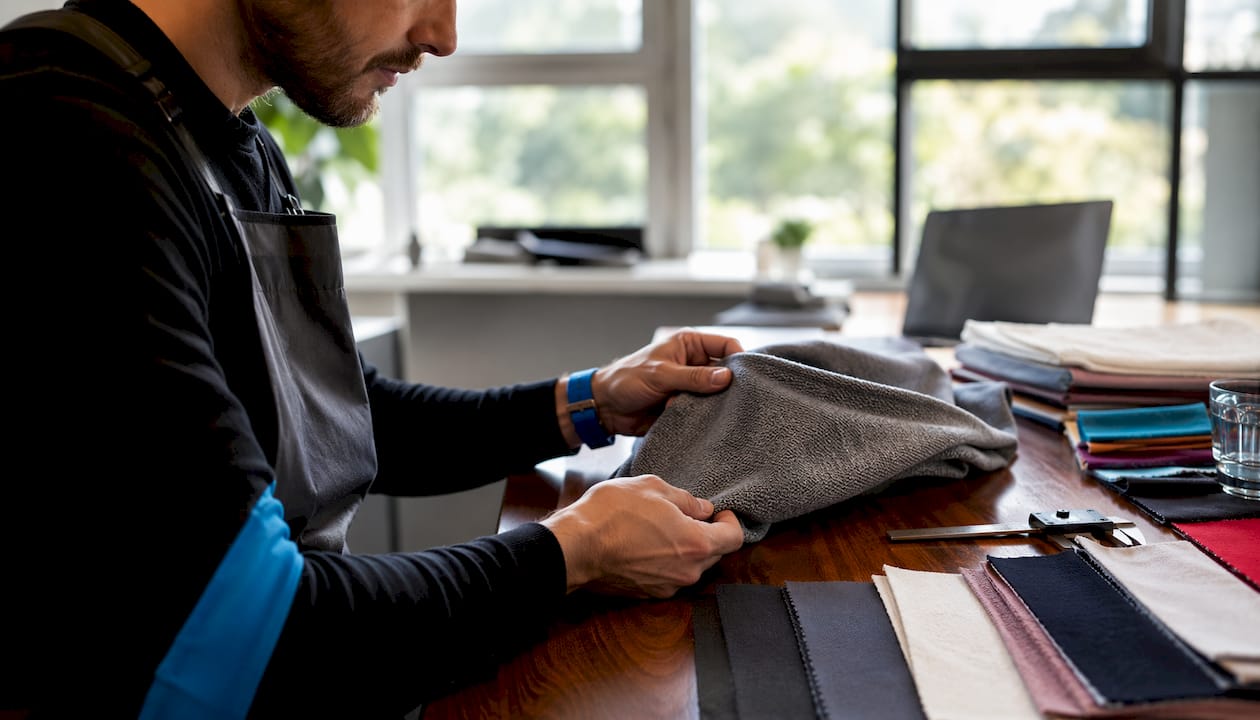
Fleece starts the same way. But after knitting, the loops on the inside are mechanically brushed and napped, shredding them into a soft, fuzzy pile. That pile traps significantly more air for insulation, which is why fleece feels warmer immediately. The trade-off: brushing weakens the yarn surface. Loft and softness degrade with repeated washing and abrasion, leading to visible pilling over time.
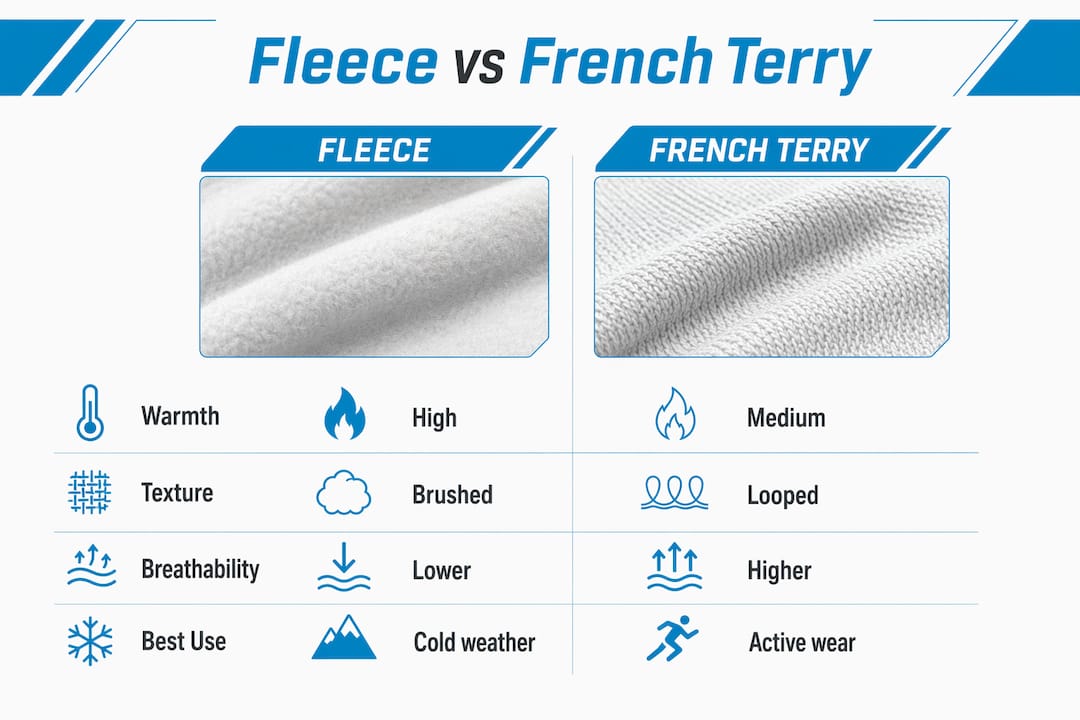
For hockey merch, that construction difference matters at every stage, from the first screen print run to the hundredth trip through the wash.
Pro Tip: When evaluating a French terry hoodie, flip it inside out and check that the loops are uniform in size and tightly formed. Loose or inconsistent loops are a sign of lower-quality knitting that will snag and lose shape faster.
Fleece vs French Terry: Side-by-Side Comparison
French terry wins on versatility; fleece wins on raw warmth. Here’s how they stack up on the axes that matter for hockey apparel.
| Category | French Terry | Fleece |
|---|---|---|
| Warmth / insulation | Medium — regulates temperature during activity | High — traps air for maximum cold-weather insulation |
| Breathability | Higher — intact loops allow airflow | Lower — brushed pile restricts airflow, can feel clammy indoors |
| Typical GSM range | 220–340 GSM; 300–340 GSM is the premium midweight sweet spot | — |
| Durability & pilling | Holds shape and resists pilling over time | Brushed surface degrades with washing; pills and loses loft |
| Fit & silhouette | Structured, clean drape — works for athletic and streetwear cuts | Heavier drape, can look slouchy; better for relaxed fits |
| Decoration compatibility | Smooth face is excellent for screen print, DTG, fine embroidery | Brushed pile can shadow prints; needs underlays or pile-specific techniques |
| Best use | 3-season layering, warmups, arena-to-street, everyday team wear | Deep-winter insulation, sideline blankets, cold-focused lounge pieces |
For branded team gear, French terry’s smooth face reduces “telegraphing,” the effect where a textured surface bleeds through and blurs a printed logo. Clean branding is non-negotiable when your hoodie is representing your team.
Which Fabric Should You Choose for Hockey Wear?
The answer changes depending on where you’re wearing it and what you’re doing.
Players warming up before a skate want French terry midweights. The fabric breathes during movement, doesn’t trap heat when you’re working up a sweat in the locker room, and layers cleanly under a shell if the rink runs cold. For high-intensity training, performance synthetics are still the better call, but for warmups and the walk from the parking lot to the ice, French terry hits the right balance.
Deep-cold sideline exposure is where fleece earns its place. If you’re a hockey mom sitting in a 55°F arena for two hours without moving, a fleece-lined piece or a heavyweight fleece hoodie keeps you warmer than any French terry option. Fleece is engineered for stationary cold. Use it that way.
Fans moving between cold stands and warm concessions are the clearest case for midweight French terry. You’re transitioning between environments constantly. Fleece overheats you the moment you step inside; French terry adapts. A 300–340 GSM French terry hoodie with your team’s logo looks sharp and stays comfortable through the whole game.
- Sizing tip: French terry’s structured drape suits both athletic and slightly oversized fits. Fleece’s heavier hand tends to exaggerate an oversized cut, so size down one if you want a cleaner look.
- Before you buy: request a swatch, confirm GSM, and ask whether the fabric has been pre-shrunk or sanforized. Cotton-heavy French terry can shrink 3–5% without pre-treatment.
- Blend advantage: A cotton-polyester blend (typically 60/40 or 80/20) reduces shrinkage, improves colorfastness, and adds recovery to the knit.
Pro Tip: Ask for the fiber content breakdown, not just the fabric name. “French terry” covers a wide range of constructions. A 300 GSM 80/20 cotton-poly blend behaves very differently from a 220 GSM 100% cotton version, especially after a season of washing.
How to Care for French Terry and Fleece Hockey Apparel
Good care habits are the difference between a hoodie that looks great after two seasons and one that pills out after ten washes.
- Wash cold, inside out, on a gentle cycle. This protects the outer face and any printed or embroidered graphics. High heat causes thermal shock to cotton-rich fibers and flattens fleece loft permanently.
- Skip the high-heat dryer. Avoid high dryer heat for both fabrics. Air-dry or use the lowest heat setting. For fleece, high heat is the fastest way to kill loft and accelerate pilling.
- Reshape while damp. Pull heavy pieces back into shape before they dry. This is especially important for French terry hoodies, where the cuffs and hem can distort if left bunched in the dryer.
- For fleece: Use a lint roller after washing to remove loose fibers. If the pile starts to mat, a light unidirectional brush with a fabric brush can restore some texture. Avoid washing fleece with items that shed lint, like towels.
- For French terry: The loop side is the vulnerable side. Washing inside out protects it. Watch for snags on the loop face; a loose loop can be carefully trimmed without unraveling the knit.
- Know when to retire a piece. Pilling on French terry’s outer face is rare but fixable with a fabric shaver. Structural degradation on fleece, where the pile has thinned and the fabric feels stiff, means the insulation is gone and the piece has run its course.
Puckfuel Hockey Hoodies and Tees Built for the Rink and the Street
Puckfuel builds most of its hockey hoodies and tees in midweight French terry because the fabric earns its place at every step: it holds a clean silhouette, takes a sharp print, and stays comfortable whether you’re in the locker room, the stands, or the coffee shop after the game. The smooth face means your team’s logo looks exactly the way it should, not blurred by a textured pile or faded after a handful of washes.
The Puckfuel catalog covers midweight French terry hoodies, team tees, and lightweight layering pieces designed for players, fans, and hockey moms who want gear that works in real life, not just on the ice. Every piece is built with the arena-to-street transition in mind.
Ready to find your fit? Browse the full hockey apparel collection at Puckfuel, where you can check sizing, styles, and designs built for the hockey community.
Key Takeaways
Midweight French terry (300–340 GSM) is the best default fabric for hockey hoodies and tees because it balances warmth, breathability, print clarity, and long-term durability across arena and everyday settings.
| Point | Details |
|---|---|
| Default fabric choice | Midweight French terry handles arena transitions and holds print clarity better than fleece. |
| When fleece wins | Choose fleece for deep-winter sideline use or stationary cold exposure where maximum insulation matters. |
| GSM matters | Confirm midweight range for premium French terry; request a swatch and check fiber blend before buying. |
| Care essentials | Wash cold inside out, avoid high heat, and reshape while damp to preserve loft, loops, and graphics. |
| Puckfuel’s pick | Puckfuel stocks midweight French terry hoodies and tees built for arena-to-street hockey wear. |
Why French Terry Is the Right Call for Most Hockey Gear
The conventional wisdom on this comparison usually frames it as “French terry for spring, fleece for winter.” That framing misses the point for hockey apparel specifically.
Hockey players and fans don’t live in one temperature. You go from a 30°F parking lot to a 55°F arena to a 70°F concession stand and back again, sometimes in under an hour. A fabric that commits you to one thermal state, the way fleece does, works against you in that environment. French terry doesn’t. The intact loop structure lets air move, which means the fabric adapts instead of trapping heat the moment you step inside.
The branding argument is just as strong. A hockey hoodie is a statement. The logo on the chest represents your team, your kid’s team, or the sport you’ve given years to. Fleece’s brushed pile introduces risk at every print run: telegraphing, ink absorption issues, and a surface that degrades faster than the graphic on top of it. French terry’s smooth face holds that graphic the way it was designed to look.
Fleece has a real role. Sideline blankets, deep-winter lounge pieces, and cold-focused accessories are where it belongs. But for the hoodie you wear everywhere, the one that represents hockey as a lifestyle, midweight French terry is the fabric that delivers.
Useful Sources and Further Reading
- French Terry vs Fleece Hoodies: Technical Fabrication Guide — Mavyq: construction details, decoration compatibility, and print performance.
- French Terry vs Fleece Comparison — WhiteCotton: GSM ranges, midweight sweet spot (300–340 GSM), and seasonal use guidance.
- French Terry vs Fleece Hoodie: Which Is Better — 1abel: durability, pilling, and long-term silhouette comparison.
- Fleece vs French Terry: A Sourcing Guide for Custom Sportswear Buyers — Fexwear: buying checklist, swatch requests, GSM verification, and fiber blend guidance.
- French Terry vs Fleece Complete Fabric Comparison — Nature’s Fabrics: laundering, care, and storage best practices.
- Polar Fleece — Wikipedia: fleece weight classes, loft behavior, and pilling tendencies.
- Puckfuel Hockey Apparel — Browse midweight French terry hoodies, tees, hats, and drinkware for players, fans, and hockey moms.