

DTF vs Screen Print: What Hockey Apparel Buyers Should Know
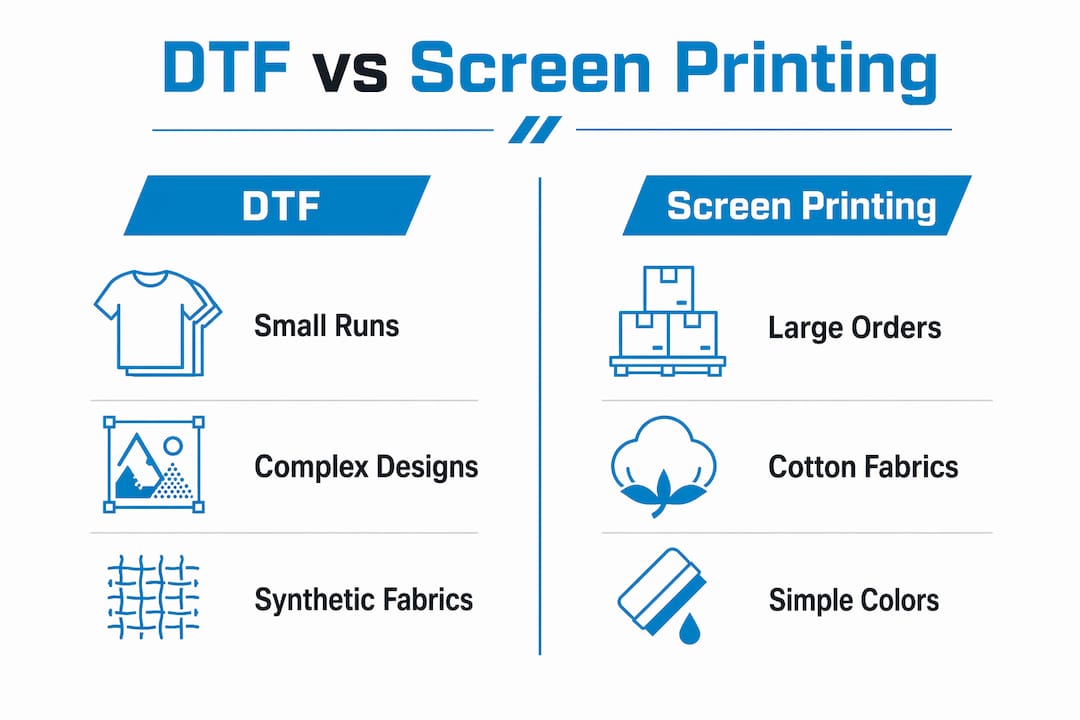
For most hockey tees and hoodies, screen printing tends to be better for larger orders on cotton; DTF is preferable for smaller runs, synthetic fabrics, or when your artwork has gradients and fine detail.
- Choose screen printing when you’re ordering 50+ pieces of the same design on cotton or cotton-blend garments, need Pantone-accurate colors, or want specialty effects like puff or metallic ink.
- Choose DTF for small batches (under 48 units), full-color or photo-quality artwork, polyester performance fabrics, or fast turnaround on complex designs.
Puckfuel’s hockey apparel is produced with everyday wear in mind, so the method behind the print matters as much as the design itself. If you’re ordering custom gear or evaluating a supplier, the crossover range of 48–72 units are your first decision checkpoint.
Table of Contents
- How does DTF vs screen printing actually compare?
- How does pricing break down, and when does screen printing get cheaper?
- How long do these prints actually last, and how should you care for them?
- Which printing method handles your hockey artwork better?
- Are there real environmental differences between DTF and screen printing?
- What should you ask before placing a hockey apparel order?
- How to inspect a sample before the full run ships
- Which method is right for your specific hockey gear?
- Key Takeaways
- Why the print method debate matters more for hockey wear than most people realize
- Puckfuel has the hockey apparel, already done right
- Useful sources
How does DTF vs screen printing actually compare?
| Dimension | Screen Printing | DTF (Direct to Film) |
|---|---|---|
| Best for | High-volume, simple-color runs | Small batches, complex or photo-quality art |
| Durability / wash resistance | 50+ washes (plastisol); 100+ on heavy cotton | 40–60 washes when cured correctly |
| Print feel (hand) | Soft, ink-into-fiber feel | Slightly thicker, film-on-surface feel |
| Design complexity & color fidelity | Pantone-accurate spot colors; struggles with gradients | Unlimited colors, gradients, photos, fine text |
| Cost profile | High setup (per screen, per color); low per-unit at volume | Minimal setup; flat per-transfer cost; higher per-unit at scale |
| Turnaround time | Longer (screen prep, registration) | Faster for small runs; no screen setup |
| Garment / fabric types | Best on cotton and cotton-rich blends | Cotton, polyester, blends, performance fabrics |
| Environmental impact | Water-based inks can be lower-impact; wastewater management required | PET film and adhesive powder waste; some GOTS-approved DTF inks now available |
Key trade-offs at a glance:
- Screen printing delivers unmatched color vibrancy and longevity on cotton — the right call for fan tees and staff hoodies ordered in bulk.
- DTF handles what screen printing can’t: gradients, photographic player images, and performance fabrics without dye migration risk.
- Screen printing’s per-unit cost drops sharply with volume; DTF stays relatively flat regardless of run size.
- DTF equipment demands daily maintenance — white ink clogs fast — so shop reliability matters.
Pro Tip: Sample with DTF, scale with screen printing. Order a DTF proof to verify placement and color, then switch to screen printing once you hit 48–72 units. You get accuracy without paying screen setup costs on a design that might still change.
How does pricing break down, and when does screen printing get cheaper?
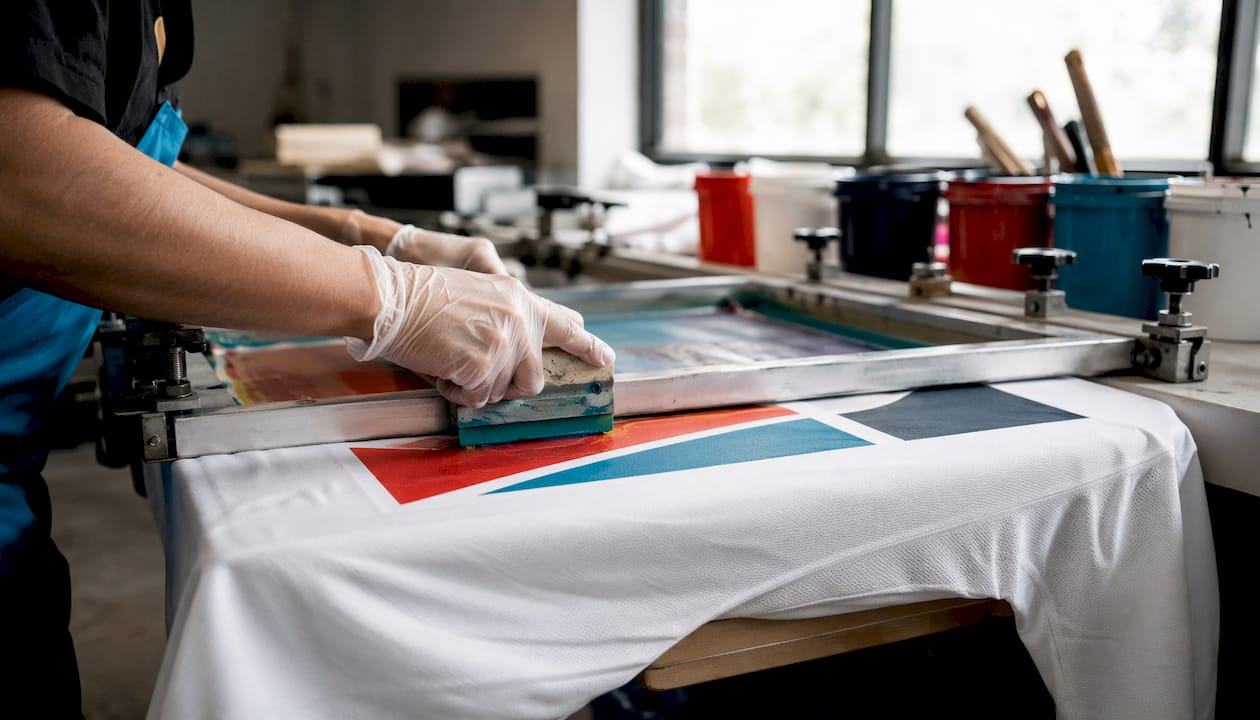
Screen printing charges a setup fee for every color in your design, as each color requires its own screen. This adds to your upfront cost before a single shirt is printed. Once setup is complete, the per-unit price typically decreases as volume increases.
DTF flips that model. There’s no per-color setup. You pay a largely flat per-transfer rate, which makes small runs genuinely affordable. The cost dynamics shift at a certain quantity: below that threshold, DTF usually costs less; above it, screen printing’s amortized setup makes it the better deal.
Costs buyers often overlook:
- Underbase screens on dark garments (adds one extra screen and one extra pass)
- Artwork cleanup or vectorization fees if your file isn’t print-ready
- Proof or strike-off charges before a full run
- Reorder pricing — screens may be stored or may need to be remade
Ordering tactics worth using:
- Ask whether screens are stored after your run and for how long — reusable screens cut reorder costs significantly.
- Request a per-unit price quote at three quantity breakpoints (24, 72, and 144 units) so you can see exactly where the crossover hits for your specific design.
- For DTF, ask whether transfers can be pre-produced and stored — some shops will print and hold transfers so you can heat-press on demand.
Pro Tip: For a four-color hockey crest on a black tee, get quotes at 36 and 72 units from both methods. The difference is often $3–$6 per unit at the crossover, and that gap tells you exactly which method fits your budget.
How long do these prints actually last, and how should you care for them?
Screen printing, done right on heavy cotton, is the durability leader. Plastisol inks can survive 50+ washes without meaningful fading, and well-cured prints on quality cotton can push well past 100 washes. DTF is competitive but more variable: properly cured transfers typically last 40–60 washes, while a poorly cured transfer can crack or peel in as few as 20 washes. Cure temperature and press pressure are everything.
Care instructions for both methods:
- Wash inside-out in cold water (30°C / 86°F or below)
- Use a mild, dye-free detergent; avoid bleach or fabric softener on the print area
- Tumble dry on low heat or hang dry — high heat accelerates edge lifting on DTF
- Never iron directly on the print; use a pressing cloth or iron inside-out
- For DTF specifically, avoid dry cleaning solvents near the transfer
Common failure modes by method:
- Screen print: cracking at stress points (collar, underarm seams) on older plastisol; fading on low-cure jobs; color shift on polyester without proper inks
- DTF: edge lifting, especially on stretchy fabrics; shiny adhesive residue if powder wasn’t fully cured; opacity inconsistency across a run if the printer skipped maintenance
Pro Tip: On a sample, press your thumbnail firmly against the print edge and drag slightly. A well-cured DTF transfer won’t lift or leave a shiny adhesive trail. If it does, the shop’s curing parameters are off — ask for a reprint before approving the full run.
Which printing method handles your hockey artwork better?
Screen printing strengths:
- Pantone-matched spot colors — critical for team crests with exact brand colors
- Specialty inks: puff, metallic, glow-in-the-dark, and high-density effects
- Bold, flat graphics with strong opacity on dark garments
- Classic soft-hand feel, especially with water-based or discharge inks
Screen printing limits:
- Photorealistic gradients require simulated process printing (expensive, more screens)
- Each additional color adds setup cost and registration complexity
- Not reliable on polyester without dye-blocking inks
DTF strengths:
- Unlimited colors, fine gradients, and photographic detail with no per-color charge
- Sharp small text — sponsor names on sleeves, player numbers with fine outlines
- Variable data per piece (different names or numbers on each garment in one run)
- Works on polyester performance fabrics without dye migration
DTF limits:
- Slightly thicker hand feel on large solid-color fills
- Cannot replicate puff, metallic, or embroidery texture
- Adhesion depends on correct cure — inconsistent shops produce inconsistent results
Hockey-specific design examples:
- Team-style name and number sets: DTF handles variable data per jersey; screen printing is better for a uniform set of 50+ identical numbers.
- Photoreal player images or action shots: DTF only — screen printing can’t reproduce photographic gradients without significant cost.
- Multi-color crest logos: screen printing for 4 colors or fewer at volume; DTF for 5+ colors or small runs.
- Small sponsor text on sleeves: DTF’s fine-detail reproduction wins here.
Pro Tip: Supply vector files (AI or EPS) for screen printing and high-res raster files (300 DPI minimum, RGB or CMYK depending on your shop’s spec) for DTF. Wrong file format is the single most common cause of artwork delays.
Are there real environmental differences between DTF and screen printing?
Honestly, neither method is clean by default. The difference is in where the waste comes from.
DTF environmental concerns:
- PET film is single-use and not widely recyclable through standard municipal programs
- Thermoadhesive powder adds a waste stream most shops handle inconsistently
- Some GOTS-approved water-based DTF inks now exist, but they’re not yet universal
Screen printing environmental concerns:
- Solvent-based plastisol inks contain PVC and phthalates; disposal requires care
- Water-based and discharge inks are lower-impact but require proper wastewater treatment
- Screen reclamation chemicals add another waste stream
Sustainability varies significantly by shop — a screen printer using water-based inks and responsible wastewater management can be meaningfully greener than a DTF shop discarding PET film carelessly.
Pro Tip: Ask your printer directly: “What ink system do you use, how do you handle film waste, and do you hold any environmental certifications?” A shop that can’t answer clearly probably hasn’t thought about it.
What should you ask before placing a hockey apparel order?
- What’s your minimum order quantity for each method?
- What’s the standard lead time, and does it change for rush orders?
- Can I get a physical proof or sample on the exact garment and color I’m ordering?
- What fabric do you recommend for this print method and design?
- How do you match colors — Pantone, digital proof, or press match?
- Do you have wash test data for this method on this fabric?
- What’s your policy if the first shipment has quality issues?
- How quickly can you turn around a reorder, and are screens stored?
Red flags to watch for:
- Vague answers about wash testing (“it should be fine” is not data)
- No ability to show a cured sample on the actual garment color
- No disclosed maintenance schedule for DTF equipment
- Refusal to name ink type or film supplier
Pro Tip: Always request two things before approving bulk production: a photo of the cured print under direct light (to check opacity and edge quality), and a physical swatch heat-pressed onto a scrap of the actual garment fabric. Both together take less than 48 hours and save you from a bad run.
How to inspect a sample before the full run ships
Open the first box and run through this checklist before signing off:
- Edge adhesion: press a fingernail along the print perimeter — no lifting, no peeling
- Hand feel: does the print feel consistent with what was agreed? No unexpected stiffness or rubbery texture on large fills
- Color vibrancy: compare against your approved proof under natural light, not just indoor fluorescents
- Registration and placement: measure from collar and side seam to confirm placement matches spec
- Seam interaction: check that the print doesn’t crack or distort where it crosses a seam
- Wash test: run one piece through a hot wash and low-heat dry cycle before approving the full shipment
Pass/fail prompts:
| Check | Pass | Fail |
|---|---|---|
| Edge adhesion | No lift under fingernail pressure | Any peeling or shiny residue |
| Color match | Within visible tolerance of proof | Noticeably lighter, darker, or shifted hue |
| Placement | Within ¼ inch of spec | Off-center or misaligned |
| Post-wash | No cracking, no fading | Visible crack lines or color loss |
If you find defects, photograph them against a neutral background with a ruler for scale, note the garment count affected, and send both to your supplier within 24 hours of receipt.
Which method is right for your specific hockey gear?
- T-shirts (cotton): default to screen printing for 50+ units. Bold, flat hockey graphics on 100% cotton are exactly what screen printing was built for.
- Hoodies (heavy cotton): screen printing for large runs; DTF for small premium batches, mixed-fabric styles, or designs with gradients.
- Hats: embroidery is the preferred method for structured caps. DTF works on flat-brim synthetic caps where embroidery isn’t practical.
- Drinkware: neither DTF nor screen printing applies here. Direct sublimation or pad printing are the standard methods for mugs, tumblers, and bottles.
By use case:
- Fan tees for game day: screen printing at volume, DTF for limited-edition drops
- Player warmup gear (polyester/performance blends): DTF, no question — polyester causes dye migration with standard screen printing inks
- Staff hoodies for a rink or organization: screen printing if ordering 50+; DTF if the design is complex or the run is small
Puckfuel’s catalog covers tees, hoodies, hats, and drinkware built for hockey culture and everyday wear. The designs are already optimized for the print methods that suit each product, so you’re not guessing.
Key Takeaways
Screen printing wins on cotton at volume; DTF wins on complexity, small runs, and synthetic fabrics. The 48–72 unit crossover is your clearest decision trigger.
| Point | Details |
|---|---|
| Order size rule | Below 48–72 units, DTF is usually cheaper; above that, screen printing’s per-unit cost drops sharply. |
| Fabric rule | Use DTF on polyester and performance blends; screen printing is most reliable on cotton and cotton-rich garments. |
| Design complexity rule | Gradients, photos, and fine text favor DTF; bold spot colors and Pantone matching favor screen printing. |
| Sample inspection | Always run a wash test and edge-adhesion check before approving a full run. |
| Puckfuel | Ready-made hockey apparel for tees, hoodies, hats, and drinkware — no print decisions required. |
Why the print method debate matters more for hockey wear than most people realize
Here’s what most print comparison articles miss: hockey apparel lives a harder life than a typical branded tee. It gets worn to the rink, thrown in a bag, washed after sweaty games, and expected to look sharp at the bar afterward. That’s a real durability test.
The choice between DTF and screen printing isn’t just economics. It’s about whether a hoodie’s chest graphic survives a season of that cycle. Screen printing on quality cotton earns its reputation because the ink becomes part of the fiber. DTF, when cured correctly, holds up well — but “when cured correctly” is doing a lot of work in that sentence. A shop that skips maintenance or rushes cure time will produce transfers that fail by mid-season.
For everyday hockey wear, comfort and longevity matter as much as the visual. A print that cracks after ten washes isn’t premium, regardless of how sharp it looked on day one. That’s why asking for a wash-tested sample isn’t being difficult — it’s the minimum standard for gear you’re going to wear proud.
Puckfuel has the hockey apparel, already done right
You’ve done the research. Now skip the print-method guesswork entirely. Puckfuel’s hockey tees, hoodies, hats, and drinkware are designed for players, fans, and hockey moms who want to wear the sport every day, not just on game night.
Every piece in the catalog is built around a clean, athletic aesthetic with bold graphics that hold up through real wear. If you want hockey apparel that looks sharp on the street and survives the wash cycle, browse the full collection at Puckfuel and find the style that fits your game.
Useful sources
- Screen Printing vs DTF: Differences and When to Use Each — French Press Custom: cost crossover math, durability benchmarks, and method comparison
- DTF Printing vs Screen Printing: Cost, Quality & Durability — Apex Workwear: curing parameters, wash-range data, and sustainability trade-offs
- DTF vs Screen Printing Comparison Guide — SkyPrintHouse: situation-dependent method selection guidance
- Screen printing vs DTF — Badger Prints: DTF maintenance requirements and operational risk
- The Pros & Cons of Direct-to-Film (DTF) Printing — Southern Style Graphics: fine-detail and gradient reproduction capabilities
- Screen Printing vs Direct-to-Film Printing — BlueCotton: fabric compatibility, polyester dye migration, and method suitability